


AI visibility and Google SEO are one connected system. Strong SEO gets a page retrieved. Passage-level relevance, entity clarity and brand trust determine whether an AI system actually selects and cites it once it's there.
That means you shouldn't buy a separate "GEO" foundation running alongside your SEO. Protect the shared substrate you already have, then add a smaller, measurable layer of work aimed specifically at retrieval, selection and AI-visibility testing.
TL;DR
- Good SEO is the entry ticket. If you're not indexed and ranking, you're not in the conversation. Google is right about that, and its own VP now says so publicly.
- But ranking gets you shortlisted, not selected. Top-10 Google presence and AI citations have decoupled. Ahrefs' data shows 76% overlap falling to 38% in a year.
- The new work happens after retrieval: which passage gets chosen, which brand gets named.
- Treat it as one system with five stages. Stages 1 and 2 are classic SEO. Stages 3 to 5 are the new discipline.
- Don't buy llms.txt, AI schema hacks, "agent-ready" retrofits, Open Knowledge Format files, or "AI rewrite" services as citation levers. Google asks for none of them, and the evidence says some of them actively backfire.
- Budget guidance: roughly 90% of spend on the shared foundation, 10% on the AI-specific layer. Reallocate what you already spend. Don't duplicate it.
Google's own position backs half of that. Its AI features documentation says you need nothing beyond the SEO fundamentals you should already have covered: an indexed page, a crawlable site, eligibility for a snippet.
In June 2026, Google's VP of Search and Commerce, Brendon Kraham, said much the same thing in plain English. Writing on Think with Google, he put it in four words that have since travelled further than most corporate blog posts ever do: good SEO is good GEO.
But a July 2026 academic paper reached a noticeably less comforting conclusion. It reviewed 45 separate studies on generative engine optimisation and found that generic SEO heuristics transfer poorly to generative engines. Some of the rewrites people make specifically to chase AI citations actively hurt their chances of being retrieved at all.
And in the same window, Ahrefs published new research tracking 863,000 keywords and more than four million AI Overview URLs. The overlap between ranking in Google's top 10 and being cited in an AI Overview has fallen from 76% to 38% in under a year.
Both things are true at once. Google is right about what its own systems require. That requirement alone no longer explains who gets cited. The rest of this piece is about the gap between the two, and why almost nobody selling GEO packages right now wants to explain it to you properly.
The false choice being sold to you
A separate GEO retainer usually duplicates the SEO foundation that already determines whether AI systems can retrieve your site. That's the trap.
Right now, plenty of businesses are being offered a "GEO package" as a separate line item.
Sometimes it's a separate retainer. Sometimes it's a whole separate agency, brought in to run alongside your existing SEO team, as if AI visibility were its own channel with nothing to do with the one you already fund.
There are two ways this goes wrong.
The first: you pay twice for the same foundational work. Your SEO agency is quietly doing the technical and content groundwork that AI visibility depends on, while a new GEO vendor charges you again to "optimise" the same territory under a different name.
The second is worse. You fund an AI strategy that's disconnected from the thing that actually feeds it: your ranking performance. You end up with a shiny llms.txt file sitting on top of a site that barely gets crawled in the first place.
Why did this happen? Fear sells, and a new acronym resets everyone's perceived expertise back to zero. The moment "GEO" entered the vocabulary, a decade of accumulated SEO credibility suddenly looked out of date. A market of vendors rushed in to sell certainty about a topic nobody had earned certainty about yet.
To be fair, the opposite camp is just as wrong. The "nothing has changed, it's still just SEO" crowd oversimplifies too, and the decoupling data further down this piece is exactly why. Something has changed. It just isn't the thing most vendors are currently charging you for.
What Google actually asks for (and what it doesn't)
Google requires the same core conditions for AI features as it does for classic Search: crawlability, indexation and snippet eligibility. Nothing beyond that.
Here's the line-by-line check, because this is where most of the fugazi gets exposed.
Google's AI features documentation lists what actually matters: indexable content, snippet eligibility, internal links, a decent page experience, genuine textual content, structured data that matches what's on the page, and fresh Merchant Center or Business Profile data where relevant.
Read that list again. That's an SEO checklist. It always was.
Google went further in its updated guide to generative AI search. The wording is direct: you don't need new machine-readable files, AI text files, markup, or Markdown to appear in Google Search, because Google Search itself doesn't use them.
John Mueller, Google's Search Advocate, made the same point more colourfully. He's compared llms.txt to the old keywords meta tag more than once: a file where a site simply tells the crawler what it's about, which is exactly the kind of unverifiable claim search engines learned to ignore decades ago.
The data backs this up hard.
Ahrefs ran an analysis of 137,000 domains and found that 97% of the roughly 38,000 valid llms.txt files in their sample received zero requests in a month. Not from AI bots. Not from anyone.
The more useful finding sits underneath that headline number. On domains that didn't have an llms.txt file at all, AI bots never went looking for one. That matters, because it means the file can't create discovery. It can only be found by something that had already decided to look for other reasons.
SE Ranking ran an independent version of the same test across roughly 300,000 domains, with the same result. No statistically significant link between having an llms.txt file and AI citation frequency.
Their prediction model actually got more accurate once they removed llms.txt as a variable entirely. A separate analysis of nearly 95,000 cited URLs found llms.txt behind precisely one citation.
The schema story is more nuanced, and it deserves care.
Ahrefs tracked 1,885 pages that added JSON-LD schema, matched against 4,000 control pages that didn't. They measured the change in citations across Google AI Mode, AI Overviews and ChatGPT.
The result: a 2.4% shift on AI Mode and 2.2% on ChatGPT, both statistically indistinguishable from noise, and a small but real 4.6% decline on AI Overviews.
But every page in that sample already had over 100 AI Overview citations before the schema was added. Ahrefs' own earlier correlation work on six million URLs found cited pages carry JSON-LD at roughly three times the rate of pages that aren't cited.
Ahrefs flag this limitation themselves. The study tells you schema doesn't lift a page that's already in the citation set. It doesn't tell you whether schema helps a page become eligible for citation in the first place.
The nuance that matters here: structured data still earns its keep for eligibility and appearance in Search generally. It just isn't an AI-citation booster. That's the level of precision this audience almost never gets from a GEO pitch deck.
One more thing worth saying plainly: I'm not carrying Google's water here. Credible practitioners have pushed back on Google's framing as self-serving, and the academic survey mentioned earlier partially agrees with them.
Both things are true at once. Google is right about what its own systems technically require. That isn't the whole story of AI visibility. The next section is where the rest of it lives.
One pipeline, five stages, two scoreboards
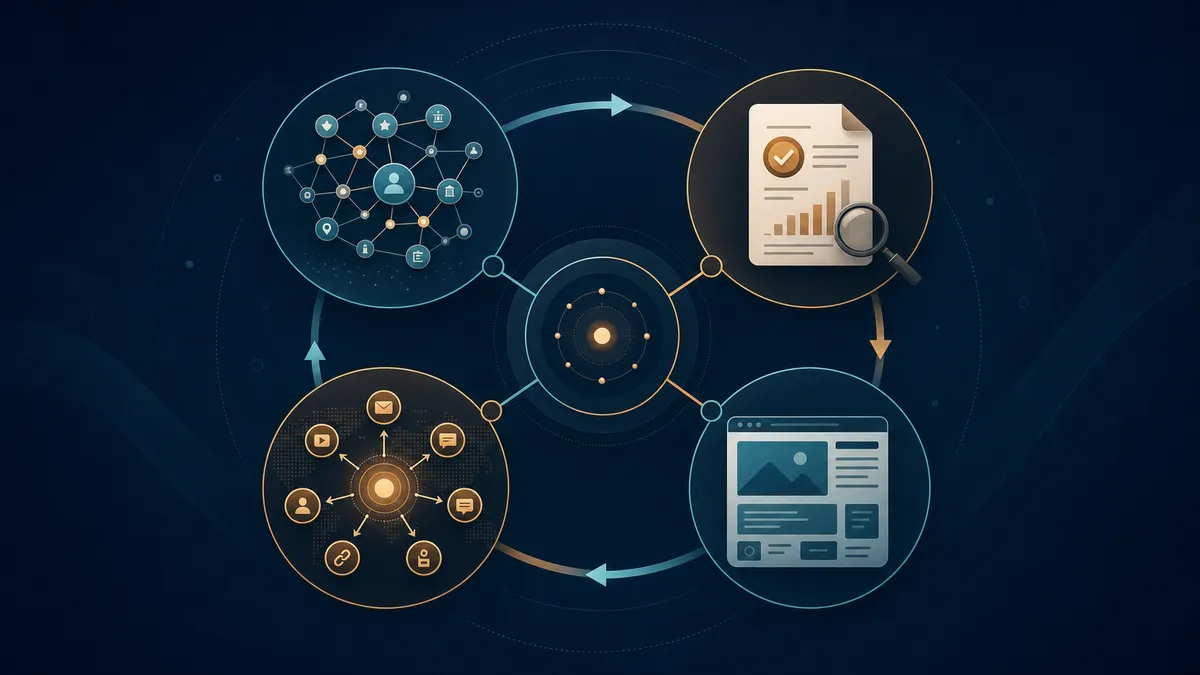
AI visibility runs through five sequential stages, and classic SEO only controls the first two. That's the model that reconciles Google's position with the academic evidence above, and it's easiest to picture as a procurement process rather than a ranking. I laid it out in more depth in Selection Rate Optimisation.
Stage one is prequalification. A public sector buyer won't consider your business unless you're on the approved supplier list. In search terms, that's crawlability and indexation. If you're not there, nothing else in this article matters to you yet.
Stage two is the tender list. The buyer pulls together a shortlist of suppliers worth investigating properly. This is retrieval and fan-out: the process by which an AI system breaks your query into a cluster of related sub-questions and gathers candidate sources for each one.
Google confirms this is exactly how AI Overviews and AI Mode assemble their source pool. I've written separately about how to reverse-engineer what those hidden sub-questions actually look like in Fan-Out Query Reverse Engineering.
Stages three and four are the shortlisting call and the final interview. This is where classic SEO stops helping and passage-level engineering takes over.
Across my own analysis of 385 passages, entities named explicitly in the text saw a 2.7 to 4.2x lift in selection likelihood. Answer-first structure consistently beat narrative build-up. I cover both in Selection Rate Optimisation: What Wins and What AI Cites From Long-Form Pages.
Stage five is the contract award, and it's really about synthesis. This is where brand safety and calibration come in: whether your own content can be manipulated or misread once it's inside a model's context window. I've covered the specific failure mode I call the Injection Paradox in Content Manipulation: Claude vs GPT.
Nobody wins the contract at prequalification. That's the whole argument in one sentence. Classic SEO gets you into the room. On its own, it doesn't get you the answer slot.
This is also where the two scoreboards live. Google keeps a scoreboard of rankings and clicks. AI surfaces keep a separate scoreboard of citations, mentions and selection.
It's the same underlying system producing two different sets of numbers. And within the AI scoreboard, the platforms don't behave the same way as each other.
A recent study of 320 buyer queries found that Google's own AI Mode pulls 93% of its citations from Google's top 10 organic results, and Perplexity pulls 89%. ChatGPT, by contrast, pulls just 30%, with almost no correlation to Google rank at all.
The scoreboard split isn't really "Google versus AI." It's closer to "Google plus its own AI surfaces" against "ChatGPT and everything else built on a different retrieval logic." That distinction sharpens everything that follows.
One format note, since it matters for how AI systems extract content like this. Use lists for scanability, the way the workflow later in this piece does.
But keep the primary claim of each section in a complete prose paragraph too. That way it can survive extraction as a standalone passage, not just as a fragment of a bullet.
The decoupling, and why the pipeline model explains it
Google rankings still raise the odds of AI citation, but ranking alone no longer predicts which source an AI system ultimately selects. That's the headline finding of 2026, and it has stopped being a footnote.
| Study | Finding |
|---|---|
| Ahrefs (863,000 keywords, 4M AI Overview URLs) | Top-10/AI Overview overlap fell from 76% to 38% in under a year |
| SEO Floor (100,411 citation events) | Top-3 pages remain 7.8x to 34x more likely to be cited than pages ranked 31 to 100, but 75.4% of citation events land outside Google's top 30 |
| EMGI (150 SaaS companies) | 81% of brands ChatGPT cites don't rank in Google's top 10 for the same query |
| CiteLens (320 buyer queries) | Google AI Mode draws 93% of citations from Google's top 10; ChatGPT draws just 30%, with near-zero rank correlation |
Here's the paragraph that resolves the apparent contradiction, and it's the one I'd expect to see quoted back at me.
Rank still strongly predicts citation odds on a per-page basis. A top-three Google position is still worth somewhere between seven and thirty-four times the citation likelihood of a page buried at rank 31 to 100.
But Google's own top-10 pages are becoming a shrinking share of the total citation pool. AI systems are increasingly drawing from a much wider universe of sources: forums, YouTube, and pages that never crack the top 100 at all.
That's exactly what a five-stage pipeline predicts. Retrieval opens the field wide. Selection narrows it again. The two stages answer to different signals.
The business consequence is straightforward. A rank-one position is still worth having. The gradient is real and the multiplier is large.
But a rank-one strategy on its own is no longer sufficient for AI visibility, and the gap between the two keeps widening every quarter.
The 90/10 rule for budgets
Roughly 90% of your search budget should fund the shared SEO foundation, and 10% should fund AI-specific passage work and measurement. Here's how that splits in practice.
The 90% covers your technical foundation, information architecture, content quality, entity clarity, and digital PR or authority building.
This is the budget that serves both scoreboards at once. That's the entire integration argument compressed into a single sentence: you are not buying SEO or AI visibility as two separate products. You are buying the shared substrate that both scoreboards read from.
The 10% covers passage-level optimisation of your genuinely important pages, brand-mention and entity building, calibrating content for how different AI models actually behave, and measurement, which turns out to be its own discipline entirely (more on that later in this series).
What the 10% is not: llms.txt, AI-specific schema hacks, daily AI-ranking dashboards, "AI content rewriting" services, Open Knowledge Format files marketed as citation levers, and WebMCP retrofits sold to you as "AI SEO."
"AI content rewriting" deserves a specific warning. The academic survey referenced earlier found citation-oriented rewrites can actively impair retrieval. That's not just wasted spend. It can work against you.
Here's a table worth screenshotting for the next time an agency proposal lands in your inbox.
| If your agency proposes... | It belongs in... |
|---|---|
| llms.txt file creation | Red flag |
| AI-specific schema markup | Red flag |
| Open Knowledge Format files | Red flag |
| WebMCP endpoints sold as "AI SEO" | Red flag |
| "AI content rewriting" services | Red flag |
| Daily AI-ranking dashboards | Red flag |
| Entity and brand-mention building | The 10%, green flag |
| Passage-level testing against real prompts | The 10%, green flag |
Agent-ready is not the same as AI-search-visible
WebMCP and Open Knowledge Format are not AI-search-visibility levers, even though both are increasingly sold to confused business owners as "AI SEO." They're infrastructure built for a different job entirely.
WebMCP moved from a W3C Community Group draft in February 2026 into Chrome origin trials running through the second half of the year. It lets a website expose structured tools that a browsing agent can call directly, instead of guessing its way around the page.
Google Cloud published its Open Knowledge Format in June 2026, then added a trust and provenance layer in version 0.2 that July. By Google's own description, it's built for enterprise data such as table schemas, metric definitions and internal runbooks, not for public web pages competing to be cited.
Both are infrastructure for a different job. WebMCP is about autonomous agents taking actions on your site: booking, comparing, checking out. Open Knowledge Format is about internal and agent-to-agent knowledge sharing inside a business.
Neither one is a citation lever. I'd position both exactly the way I'd position llms.txt: build them if you have a genuine operational reason to, not because a GEO vendor has rebadged them as an AI-search product.
One sentence of disambiguation is worth more than a page of caveats: agent-readiness for autonomous browsing agents is a different discipline from AI search visibility, and this piece is about the latter. Keep that distinction in your back pocket and you'll save yourself from most of the confused "agent-ready website" content currently flooding the industry.
How the work actually gets sequenced
The work runs in five sequential steps: classify, map, test, defend and verify. I've built a free tool for each stage, so you can start without hiring anyone.
- Classify which of your queries even route through AI answers in the first place. Not every query does, and treating them all the same wastes budget. Run them through the Grounding Query Classifier and read the four-quadrant model behind it in Grounding vs In-Model. Some queries are winnable with content alone. Some need a twelve-month brand-building play before they move at all.
- Map the hidden sub-questions an AI system generates behind your target query, using the Query Fan-Out Gap Analyser.
- Test whether your key passages actually win selection, using the SRO Snippet Tester.
- Defend against brand copy that inadvertently trips an AI safety filter, using the Injection Risk Scorer.
- Verify, and keep verifying. A single snapshot tells you almost nothing, because AI answers are stochastic by design. My Answer Stability Checker, which measures live-grounding stability across repeated runs, is the fifth tool in this chain and will be available shortly. Pair it with Common Crawl's free AI Visibility Audit, which checks your standing in the training data itself rather than in live retrieval. The two check genuinely different things. Use both.
What stays true no matter which way the market breaks
Regardless of which AI platform gains share, crawlability, information quality, entity clarity and authority remain the shared retrieval foundation. That's the answer to a particular kind of anxiety going around at the moment, and it's worth addressing directly.
Nobody knows for certain whether AI Mode keeps growing, whether ChatGPT keeps taking share, or whether the whole category plateaus next year. Businesses are being asked to commit budget against that uncertainty, and it's a reasonable thing to feel uneasy about.
Here's what doesn't change regardless of how that plays out: every generative surface sits downstream of retrieval, and retrieval rewards the same substrate it always has.
The decoupling data, 76% down to 38% and still moving, is the number to watch. At this point, "monitor it" understates what's actually happening.
The direction of travel is clear enough that the sensible move is to plan for the gap to keep widening rather than wait and see. Build the substrate properly now, and you've hedged against every version of how this market eventually breaks.
The honest bit
The 90/10 allocation is a strategic heuristic, not a universal measurement, and platform-specific retrieval behaviour can shift that split by sector. That's the first of a few limitations worth naming plainly, because a piece this confident deserves at least one section that isn't.
The five-stage pipeline model simplifies a genuinely messy reality. Platforms differ from each other in ways that matter.
My own testing shows Gemini and ChatGPT reward different passage lengths. The CiteLens data confirms the platform gap exists at the level of which sources get cited in the first place, not just how those sources are written.
The decoupling percentages vary depending on methodology. Different studies put the current top-10 overlap anywhere from under 20% to 38%, though the direction is stable across every one of them. I've quoted the Ahrefs figure throughout because it's currently the most-cited number in the industry, but it isn't the only one.
And finally, nobody, including Google, has published causal proof that any specific AI-optimisation tactic increases citations. What exists is correlational evidence plus a plausible mechanism. If someone tells you otherwise, ask them to show their working.
Quick answers for busy decision-makers
Do I need a separate GEO agency?
No, not as a separate function from SEO. AI visibility depends on the same crawlability, indexation and content quality your SEO programme should already be delivering, plus a smaller layer of passage-level and entity work. A disconnected GEO agency bolted on top usually means paying twice for the same foundation.
Should we create an llms.txt file?
Not as a citation strategy. Ahrefs found 97% of llms.txt files get zero requests, and Google's own documentation says the file isn't used by its generative AI features at all. If you have a genuine reason to publish one for other agent tooling, it won't hurt you, but don't expect it to move citations.
How should we split budget between SEO and AI-visibility work?
Roughly 90% into the shared SEO foundation: technical health, content quality, entity clarity and authority building. The remaining 10% into passage-level testing, brand-mention building and measurement. Treat it as reallocating existing spend, not adding a second budget line.
Where this leaves you
The practical implication is simple: run one integrated search programme, not two disconnected SEO and GEO workstreams. Building that is precisely what my AI Systems and Search Integration work covers. If you'd rather have it led from inside your own team, that's what the fractional SEO director model is for.